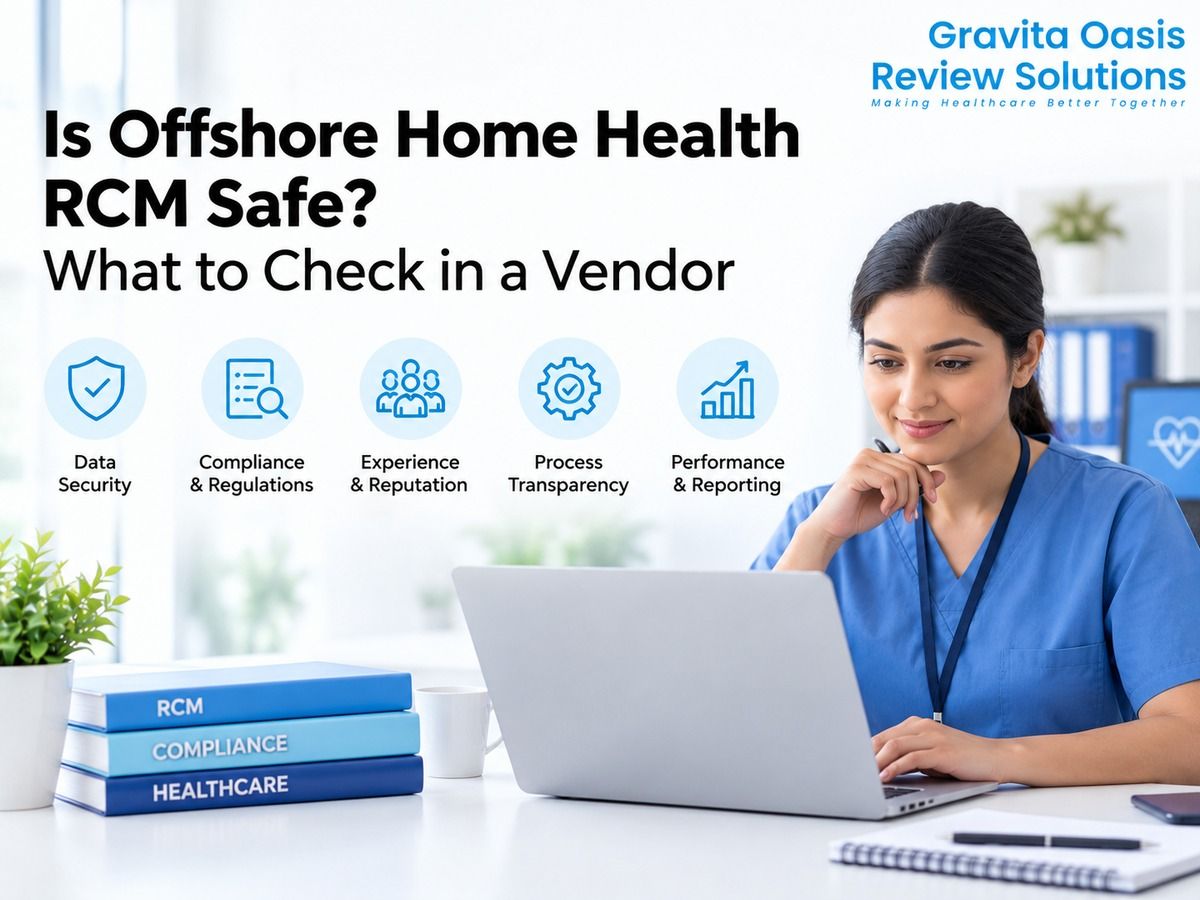
Is Offshore Home Health RCM Safe? What to Check in a Vendor
Offshore home health revenue cycle management offers agencies an opportunity to balance the volume of back-office activities like coding, documentation, billing and scheduling with the costs of providing services. Outsourcing home health billing also offers an opportunity to offload patient data and information related to clinical documentation to a third party. While outsourced home health RCM provides opportunities for cost efficiencies and billing accuracy, it also creates potential threats to patient information and documentation accuracy, as well as risks to compliance with health regulations.
If you are a home health agency, the safe bet for your business is to protect yourself. To make your decision easier, this guide will provide a thorough examination of outsourcing the billing and coding functions of your agency.
Is Offshore Home Health RCM Safe?
Yes, outsourcing offshore home health revenue cycle management is safe when the vendor adopts and follows established privacy, security, quality control and other contractual obligations. An efficient offshore vendor will show how it protects ePHI, audits ePHI access, and controls ePHI usage, maintains workflow accuracy and has processes to address security incidents.
Agencies need to understand that the compliance responsibilities that were once considered part of a business’s core operations continue to apply once business is outsourced. This is because agencies retain the ability to choose their business partners and the oversight responsibilities.
Why Home Health Agencies Consider Offshore RCM?
Home health agencies take care of all aspects of billing. Eligibility checks, coding, and documentation review are all part of this. There are a lot of tasks for each patient's billing process. Doing this internally takes a lot of time.
It can be difficult to manage home health billing internally and hiring teams of professionals can become very expensive for an agency. Outsourcing to home health RCM helps to manage backlogs.
Reasons why home health agencies use offshore RCM:
- Operational costs are lower through the use of an offshore partner for routine billing tasks.
- Agencies can grow or shrink capacity through a flexible outsourcing model that adapts to changing demand and varying billing volume.
- Medical billing services from offshore billing partner help in the billing process from preparation to denial tracking and follow-up.
- The quality of the documentation is better supported through the reviews by the offshoring partner's OASIS billing service.
- Offshore partners provide back office administrative support, data entry, reporting, and organizational services.
It is important for home health agencies to consider more than just the price. There is also the potential that services may be low quality, under trained, or unmonitored.
Does HIPAA Allow Offshore Home Health RCM?
While the offshore handling of protected health information is not prohibited by HIPAA, healthcare organizations still have to meet HIPAA requirements.
HIPAA does not forbid offshore handling and storage of electronic protected health information provided all involved parties meet all HIPAA requirements. A BAA is required where needed. The U.S. Department of Health and Human Services (HHS) also points out the added risks to security and the difficulty of enforcing offshore contracts.
Before hiring an offshore healthcare RCM vendor, agencies should:
- Confirm the vendor's role under HIPAA.
- Execute an appropriate BAA when required.
- Review the vendor's security risk management practices.
- Limit access to authorized personnel.
- Confirm how subcontractors handle patient information.
- Establish procedures for reporting and managing security incidents.
- Review contractual requirements for data return or destruction when the relationship ends.
A BAA should clearly define permitted uses and disclosures, safeguards, reporting responsibilities, subcontractor obligations, and other applicable requirements.
Key Risks of Offshore Home Health RCM (and How to Reduce Them)
1. Patient Data Security Risks
There are multiple patient data security risks with offshore medical billing. Examples of weaknesses include poor password control, granting excessive access privileges, unsafe file transfer protocols, and poor oversight of information.
Risk Mitigation: Documented incident response protocols and staff training are required along with the implementation of multifactor authentication, encryption, activity logs, and role based access.
2. OASIS and Coding Errors
Incorrectly completed assessment data and inaccurate coding can impact reporting, compliance and the claim process. For OASIS review services to remain compliant, they must accurately reflect the actual condition of a patient.
Risk Mitigation: Vendors should be evaluated on the following: How do they train staff? How do they ensure quality of their work? How do they handle corrections? And how do they handle the escalation of clinical questions? Finally, clinical oversight should be retained by the agencies to review and authorize the work done by the vendors.
3. Communication Delays
Often the resolution of claims and the associated documentation is delayed due to slow response times or vague instructions.
Risk Mitigation: Protocols should be established for responding, meetings, and escalation, as well as guidelines for how to handle priority and urgent requests.
4. Limited Quality Control
Vendors may choose to maximize their throughput and volume, ignoring the impact of repeated errors.
Risk Mitigation: Quantify the acceptable levels of quality, and conduct audits. Finally, create trend reports on errors and mandate that vendors implement corrective actions.
5. Regulatory and Contractual Gaps
Vendors may have gaps in security, or lack clearly defined subcontractor roles.
Risk Mitigation: Before contracting, review vendor’s policies, their evidence of security, subcontractor oversight and the level of compliance.
Offshore Home Health RCM Vendor Checklist: What to Check Before You Sign
Outsourcing is a strategic business decision that, if executed correctly, can create a competitive advantage for a company. Using the following checklist can help you compare vendors and spot areas of need before contracting with them.
1. HIPAA and contractual compliance
What is the vendor's understanding of its HIPAA responsibilities?
Does it have a Business Associate Agreement?
What are the responsibilities for reporting incidents, and for sub-contracting?
2. Data security
Does the vendor have appropriate authentication and access controls?
How is the data secured when being stored and while being transferred?
How often are the security logs and security assessments done?
What is the vendor's incident response process?
3. Staff training and access
Are staff trained on privacy, security and workflows?
Are staff roles defined in a way that limits access to data?
Is access revoked in a timely way, such as when an employee quits?
4. Experience in home health
What is the vendor’s knowledge and experience of home health billing and documentation?
Can the vendor describe their approach to physician orders, the claims process and how to follow up on denials?
How does the vendor provide their OASIS review services?
5. Quality assurance
What are the quality measures for ensuring the work is accurate and complete?
How are errors and issues with work tracked and reported?
What evidence is provided in a vendor’s quality reports and the associated corrective actions?
6. Communication and reporting
Is there an account manager?
Do you know how quickly an agency can get a reply? Are there documented procedures in the event of an issue that cannot be resolved in a reasonable amount of time?
Does the agency receive routine updates?
7. Business continuity
Does the vendor have an officially written disaster recovery and continuity plan?
What does the vendor have in place to address disruptions and other emergencies?
How will patient data be returned or destroyed securely when the contract ends?
The questions above should be answered and verified by an agency to determine if a potential healthcare RCM partner has a strong foundation and process to be a partner to the agency.
Offshore RCM Vendor Red Flags: When to Walk Away
Some warning signs suggest that a vendor may not be ready to handle sensitive healthcare workflows.
Be cautious if a vendor:
- Refuses to sign a BAA when one is required.
- Cannot explain how patient information is protected.
- Allows broad access to patient records without clear controls.
- Has no documented quality assurance process.
- Avoids questions about subcontractors or offshore access locations.
- Promises guaranteed claim approvals or zero errors.
- Offers unusually low prices without explaining its service scope.
- Cannot provide clear reporting, escalation, or incident response procedures.
Questions to Ask an Offshore RCM Vendor Before Hiring
Before selecting offshore medical billing services, ask practical questions about security, quality, and daily operations.
Security and compliance
- How do you protect patient information?
- Will you sign a BAA when required?
- Where will data be stored and accessed?
- How do you manage security incidents and subcontractors?
Experience and quality
- What experience do you have with home health RCM services?
- How do you check coding and billing accuracy?
Operations and accountability
- Who will manage our account?
- What turnaround times do you commit to?
- How often will you provide performance reports?
- What happens if service quality falls below agreed standards?
Ask for written answers and verify the claims through available evidence, references, and contract terms.
How to Start Safely: Pilot, Audit, Phase the Rollout
You do not need to do the entire outsourcing thing for the entire revenue cycle all at once. There are different stages to do this, so let’s look at them.
1. Create a Pilot: Start with one non-clinical task for the pilot and create boundaries around the system and information you give them for the pilot.
2. Create measures of success: Create your KPIs around accuracy, the time it takes for completion, rework, communication and the ability to comply with the defined process.
3. Audits of work: Create your audit documentation and perform audits to catch issues, errors and to find things you need to address to improve the performance.
4. Closing the Gaps: When results aren't where you want them to be, you need to develop a plan to fix things.
5. Continued monitoring: Perform ongoing audits and checks for your security access, quality and reports and ensure your vendors are meeting your contract terms.
This model allows an agency to trial an offshore partner by actually seeing them work in their home health revenue cycle.
How Gravita Oasis Approaches Safe Offshore Home Health RCM?
Gravita Oasis Review Solutions helps home health agencies with documentation and billing services. Their services include OASIS review, medical coding and billing, data entry, prior authorization, clinical review and other documentation and billing services.
Documentation and billing services are beneficial for agencies that need to organize records, identify missing documentation, analyze workflow for potential issues and billing needs, or support other billing services.
Services for OASIS review should accurately document the patient’s status and be in accordance with the patient’s CMS guidelines. For this purpose, CMS makes the most up to date versions of OASIS and associated documentation available on the CMS OASIS website.
Conclusion: Safe Offshore RCM Depends on the Vendor You Choose
Offshore home health RCM vendors can provide value for their clients when they have proper security, quality, and compliance measures in place to support their clients with cost control, increased administrative efficiency and increased workflow capacity.
Potential vendors should be vetted against a range of factors. These factors should include the vendor's understanding and implementation of HIPAA. To minimize the risks involved with outsourcing home health RCM, first sign an initial limited scope agreement and pilot the relationship to ensure performance and quality expectations are consistently met. Scaling up the outsourcing should be based on meeting the defined metrics, not the costs involved. Secure, reliable and efficient operations to ensure the collection of revenues should remain the primary concern.
FAQs on Offshore Home Health RCM
Q1.Is offshore medical billing HIPAA compliant?
It can be. Offshore medical billing must meet applicable HIPAA requirements, including appropriate safeguards and a BAA when required. Agencies should also assess the risks of overseas data access.
Q2.Can PHI be accessed from outside the United States?
Yes. HIPAA does not categorically prohibit overseas access, but organizations must assess and manage privacy, security, contractual, and other applicable legal risks.
Q3.What are the risks of outsourcing home health billing offshore?
Common threats and hazards include potential leaks and exposures of sensitive information, as well as problems like billing or coding inaccuracies. Communication delays can also cause problems, as well as the absence of sufficient quality controls or gaps in the compliance regulations.
Q4.Is offshore RCM worth it for home health agencies?
When vendors offer consistent, quality service and have robust security protocols and measurable results that are of clear value to an agency, then the cost of contracting should be assessed along with other risks associated with the agency's goals.
Q5.What should a BAA with an offshore vendor include?
A BAA must detail what can be done with protected health information, how it should be protected, what happens if there's a security breach, how contractors must fulfill their HIPAA obligations, and what else may be needed.
Q6.How do offshore teams keep OASIS and coding accurate?
Agencies need to use trained personnel, standardized audits, documented processes for correction and oversight to ensure that the data reported via OASIS accurately represents the patient’s status.
Q7.What is the difference between offshore and onshore RCM?
Offshore and onshore RCM can be completed with equal security, quality, and compliance oversight. The location of the teams that complete the work does not determine how the oversight is carried out.