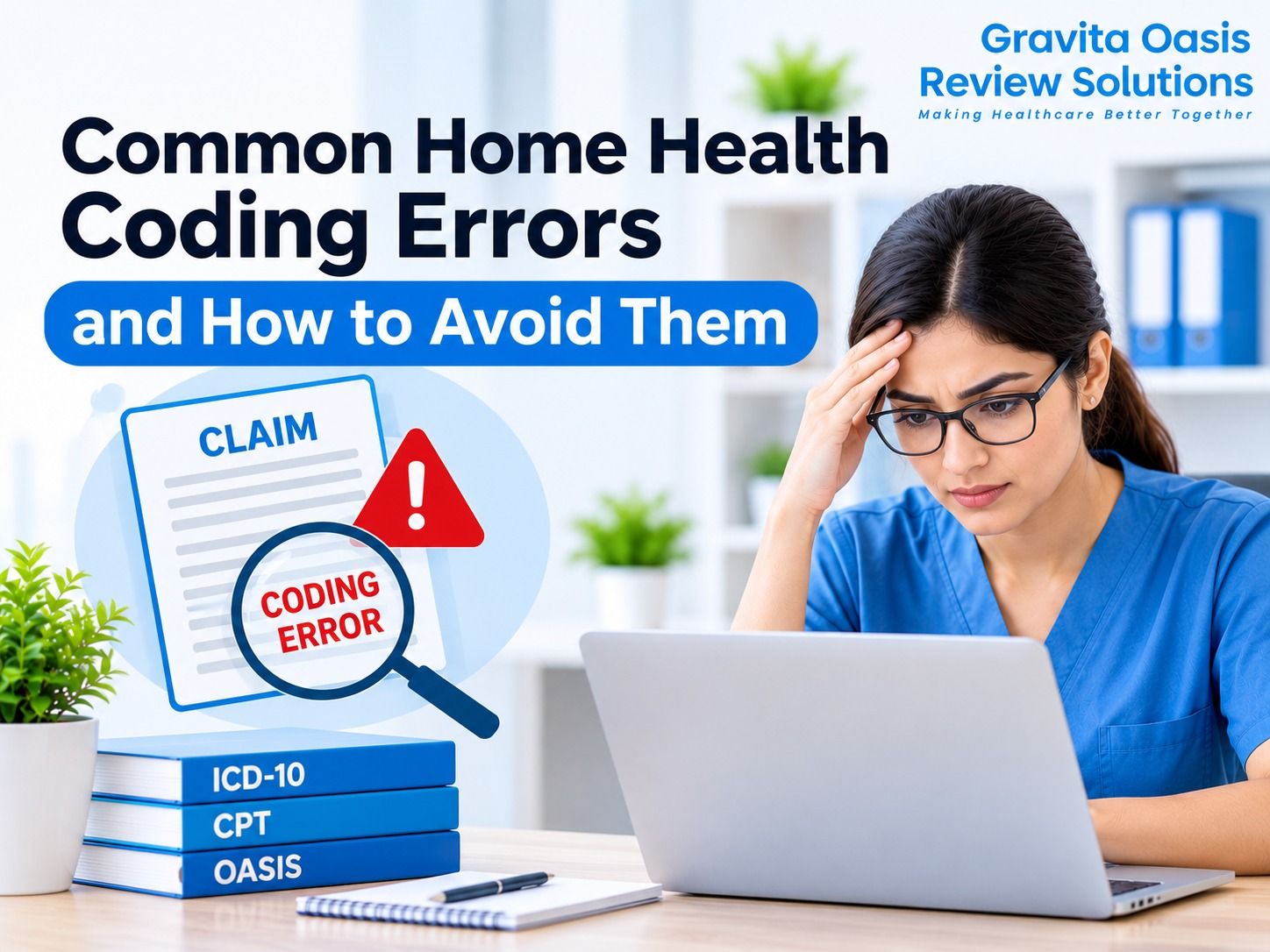
Common Home Health Coding Errors and How to Avoid Them
Coding in home health is necessary for appropriate billing, the processing of claims and remaining compliant. In home health, as in many other specialties, even small errors in diagnosis, sequencing of codes or documentation in the clinical record can lead to issues with claim processing, cause a need for the claims to be reworked, cause the claims to be denied and can cause concerns regarding audits.
Errors in home health coding can lead to a misclassification of payment and the submission of inaccurate data for payment grouping under PDGM.
Coding errors in home health can be identified by the agency prior to claim submission through review and analysis of errors in the past. Agencies that establish updated coding guidelines and have clinicians and coders work together on a regular basis are able to streamline coding workflows and reduce avoidable errors.
Why Home Health Coding Accuracy Matters More in 2026
Home health agencies are expected to adhere to a high standard for clinical documentation, diagnosis coding, and the documentation of assessments. They must ensure that the agency’s coders know and understand all ICD-10-CM standards. Agencies without the required standards are likely to see coding errors occur. The OASIS-E2 guidance (effective April 1, 2026) must be considered for all future OASIS coding.
Accurate home health diagnosis coding helps agencies:
- Claims Support: Help substantiate diagnoses through coding and clinical data found in the patient’s medical records.
- PDGM Optimization: Assisting in coding and collection of other pertinent claim information for accurate reimbursement coding under the payment models.
- Avoidable Rework Reduction: Spotting deficiencies and coding discrepancies for correction prior to claim submission.
- Audit Readiness: Maintain all documentation in a manner that will satisfy all necessary internal and external reviews.
10 Common Home Health Coding Errors and How to Fix Them
1. Selection of an Inappropriate Principal Diagnosis
The principal diagnosis impacts the PDGM diagnosis category. It is an important factor in the claim’s overall accuracy.
Correction: Revisit the documentation of the care and treatment. Ensure that the diagnoses are listed correctly.
2. Unsubstantiated or Vague ICD-10-CM Coding
Coding too broadly will likely lead to a claim being denied.
Correction: Always select the right code. Adhere to coding policies. Use the correct codes.
3. Diagnosis Sequencing Error
Diagnosis sequencing issues affect how claims are categorized for reimbursement.
Correction: Use current coding rules. Make sure diagnosis order correctly corresponds to the services rendered to a patient and the conditions the patient has.
4. Missing Relevant Secondary Diagnoses
Omitting comorbid conditions results in coding and could impact reimbursement.
How to fix: Go through the patient’s record and care plan carefully. Include those secondary diagnoses that are supported by documentation.
5. Coding Without Adequate Documentation
Assigning a diagnosis without support in the medical record creates compliance risks.
How to fix: Every diagnosis code must be clearly documented. If you cannot confirm a diagnosis from the record ask for clarification.
6. Inconsistencies between OASIS responses and Clinical Documentation
When OASIS responses don’t match the documentation it usually means an error has occurred and must be fixed.
What to do: Compare the OASIS data with the records.. Correct the discrepancy but do not change accurate clinical information.
7. Use of Old Coding Guidelines
Using codes or guidelines leads to incorrect coding and claim issues.
What to do: Always refer to the CMS guidelines and the most current ICD-10-CM code set. Staff should get training updates.
8. Ensuring the Correct Payment Group
Incorrectly coded diagnoses on claims may lead to a claim being assigned to the incorrect payment group.
How to address: Carefully review all diagnoses on a claim and make sure they are in the correct order, and check all parts of the claim for any omissions.
9. Entering Patient Information Correctly
Errors made during the data entry of patient information on an EMR, an assessment record, or a claim will result in a claim delay.
How to address: Review and correct patient information entered on the EMR and assessment records and ensure patient information on the claim form is correct.
10. Final Coding Review Omission
A well-performed coding review identifies both errors in coding and the absence of required documentation.
How to address: Perform a quality coding review before all submissions. Use a checklist to verify all documentation and coding accuracy.
How Home Health Coding Errors Affect Reimbursement and Audits?
Errors in coding for home health care may have consequences across the entire claim cycle, starting from the submission of the claim, throughout the entire reimbursement cycle, as well as the quality and audit of the records themselves.
Consequences can include the following:
- Unmet Diagnosis Coding: This category includes diagnosis coding that is absent, inaccurate or lacks additional diagnosis coding support.
- Payment Diagnosis Grouping Inaccuracy: Diagnosis coding inaccuracies can cause incorrect PDGM grouping for payment purposes.
- Payment Delay: This occurs when claim resubmission is required for claim accuracy and when claim reviews are required for additional accuracy.
- Audit Discrepancy: This category includes documentation that contains gaps or inaccuracies that cause questions or requests for more information.
- Additional Administrative Costs: These include additional resources spent in order to address rejected claims, review additional coding or even start the claim billing cycle all over again.
Not all denials occur as a direct result of improper coding. Coding is not the sole cause for all claim rejections and denials. Other areas that are just as crucial as coding include eligibility, authorization, documentation, etc.
An appropriately structured audit for coding for home health care services will provide agencies with the insight and means to address problems and issues that occur time and time again to prevent them from becoming prevalent in the industry. It should be used to support compliance and not to attempt to secure reimbursement using inaccurate coding.
How Can Home Health Agencies Prevent Coding Errors?
A coding department that consistently runs efficiently relies on systems rather than relying on one individual to do the work.
1. Implement regular trainings on all new ICD-10-CM updates, diagnosis ordering, OASIS workflow, and new PDGM regulations for all coding personnel.
2. Document checks should be done systematically by using a standardized document checklist. Ensure that all supporting documents are present.
3. Establish a workflow where coders and clinicians work together on issues that involve ambiguous documentation.
4. Coding and OASIS should be reviewed in the context of the overall patient picture. Discrepancies between assessment information and coded diagnoses should be addressed in a logical manner.
Home Health Coding Audit Checklist Before Claim Submission
Start with the list below for record preparation.
- Look at all the patient information and dates to make sure everything is right.
- Double-check the documentation for every diagnosis that was made and verify that all codes are valid and there are no missing ones for the dates of service.
- Assess the specificity of the diagnoses reported and make sure the diagnosis sequencing is appropriate.
- Look at the claim and make sure all PDGM requirements are satisfied.
- Adhere to all standard operating procedures for outstanding inquiries.
- Keep a log of all corrections that you have made.
- Perform a final review in accordance with agency policy.
Agencies are responsible for the development of their own list of checks and should incorporate any changes that take effect at their level, and with their payers, but should always comply with official coding guidance and the instructions that they receive from their payers.
How to Build a Home Health Coding QA Workflow?
Effective QA processes catch errors early in the cycle, rather than after a claim has been created.
Step 1: Check documents received during intake and identify early the missing info, making sure records needed are on hand.
Step 2: Start by completing the coding. This includes all the documentation as well as guidelines, which dictate coding.
Step 3: Check all documentation that was created with the assessments that make up OASIS. Don't assume all the coding for each diagnosis needs to be identical.
Step 4: Once everything is done, recheck the coding and all other documentation.
Step 5: Review one last time the codes that were assigned to the diagnosis along with all the required claim information.
Step 6: Use error reports to keep track of any trends related to training needs, documentation gaps, or workflow adjustments.
A coding and OASIS review program for home health agencies needs a foundation that covers responsibilities and policies and a system for measuring program effectiveness. Agency coding and review needs change frequently and require routine process updates.
How Gravita Oasis Review Helps Reduce Home Health Coding Errors?
Gravita Oasis Review offers OASIS reviews, clinical reviews, medical billing, prior authorization, data entry, and revenue cycle management to support home health organizations. Before partnering with a home health coding firm, agencies need to discuss and confirm the coding services that are needed.
An agency should consider the firm's review finding and documentation gap processes, quality control, and patient data protection. A goal should be to identify areas that need coding and support services and create a workflow for consistency and accuracy. Decisions should be made by qualified staff.
FAQs on Common Home Health Coding Errors
Q1.What are the most common home health coding errors?
Common errors include incorrect primary diagnosis selection, unspecified or invalid codes, incorrect sequencing, missed relevant secondary diagnoses, unsupported coding, OASIS inconsistencies, and outdated guidelines.
Q2.How can home health agencies prevent coding errors?
Agencies can use current coding guidelines, staff training, standardized checklists, regular audits, clear query processes, and pre-submission quality checks.
Q3.What is the difference between a primary and a secondary diagnosis in home health coding?
The primary diagnosis identifies the main condition relevant to the home health services, according to applicable coding requirements. Secondary diagnoses represent other reportable conditions that affect the patient’s care.
Q4.What happens if a home health diagnosis code is incorrect?
An incorrect code may lead to claim corrections, payment delays, denials, inaccurate payment grouping, or audit concerns. The outcome depends on the error and the applicable requirements.
Q5.How often should home health coding be audited?
Agencies should establish a regular audit schedule based on chart volume, risk, internal findings, and applicable requirements. Additional reviews may be useful when error rates increase or coding rules change.
Q6.What are common home health claim denial reasons?
Potential reasons include unsupported or incomplete documentation, invalid diagnosis codes, missing required information, eligibility issues, authorization problems, and failure to meet applicable billing requirements.